The Ethics of AI in HR: Balancing Automation with Human Touch
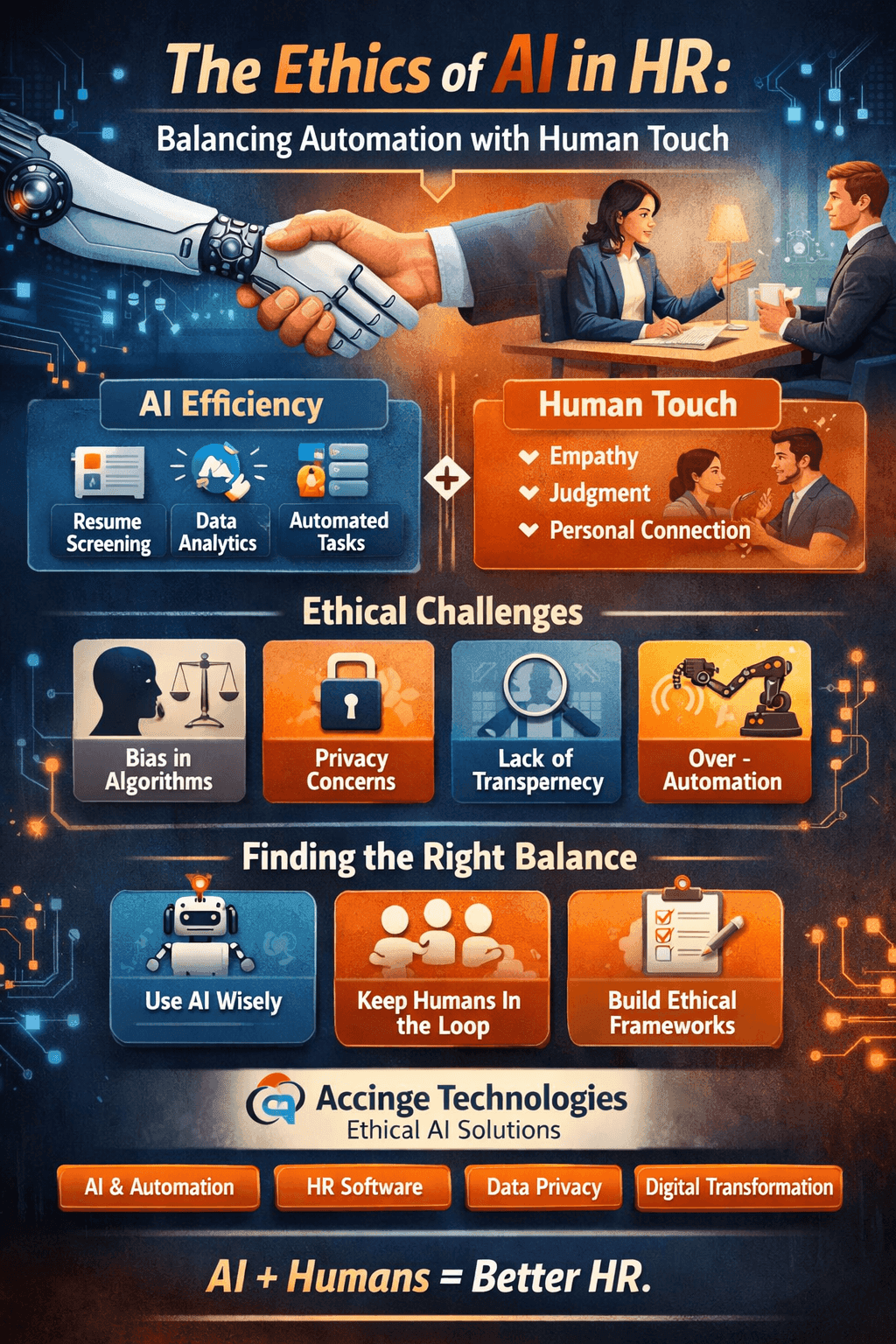
The Ethics of AI in HR: Balancing Automation with Human Touch
In today’s rapidly evolving workplace, Artificial Intelligence (AI) is transforming the way Human Resources (HR) functions operate. From resume screening to employee engagement analytics, AI is helping organizations become more efficient and data-driven. However, as we embrace automation, an important question arises: How do we balance AI efficiency with the human touch that defines HR?
At Accinge Technologies, we believe that ethical AI adoption is not just a technical decision—it’s a people-first strategy.
The Rise of AI in HR
AI is no longer a futuristic concept in HR. It is actively being used to:
- Screen and shortlist candidates
- Automate repetitive administrative tasks
- Analyze employee performance and engagement
- Predict attrition and workforce trends
- Enhance onboarding experiences
These capabilities save time, reduce costs, and improve decision-making. But with great power comes great responsibility.
Ethical Challenges in AI-Driven HR
While AI offers numerous benefits, it also introduces ethical concerns that organizations must address carefully.
1. Bias in AI Algorithms
AI systems learn from historical data. If that data contains bias, the AI can unintentionally reinforce discrimination—especially in hiring.
Example: If past hiring data favors a specific gender or background, AI might replicate that pattern.
✔ Solution: Regular audits and diverse datasets to ensure fairness.
2. Lack of Transparency
Many AI systems operate as “black boxes,” making it difficult to understand how decisions are made.
✔ Solution: Use explainable AI models and ensure candidates and employees are informed about AI usage.
3. Privacy Concerns
AI tools often rely on large volumes of employee data, raising concerns about data security and consent.
✔ Solution: Implement strict data governance policies and comply with regulations like GDPR.
4. Over-Automation
Excessive reliance on AI can strip away the human element of HR—empathy, intuition, and personal connection.
✔ Solution: Use AI as a support tool, not a replacement for human decision-making.
Why the Human Touch Still Matters
HR is fundamentally about people. While AI can process data, it cannot fully understand:
- Emotional intelligence
- Cultural nuances
- Personal aspirations
- Complex interpersonal dynamics
A candidate is more than a resume. An employee is more than performance metrics.
That’s where human judgment becomes irreplaceable.
Striking the Right Balance
To ethically integrate AI in HR, organizations must find the right balance between automation and human involvement.
✔ Use AI for Efficiency
Let AI handle repetitive and data-heavy tasks like:
- Resume screening
- Scheduling interviews
- Generating reports
✔ Keep Humans in Decision Loops
Critical decisions such as:
- Hiring
- Promotions
- Conflict resolution
should always involve human judgment.
✔ Build Ethical AI Frameworks
Create clear policies around:
- Data usage
- Bias mitigation
- Transparency
- Accountability
How Accinge Technologies Supports Ethical AI in HR
At Accinge Technologies, we help organizations adopt AI responsibly by:
- Designing bias-aware AI systems
- Implementing transparent HR automation tools
- Ensuring data privacy and compliance
- Promoting human-centric decision-making frameworks
We believe that technology should enhance human potential—not replace it.
🔗 Learn more about our solutions here:
Accinge Technologies
🔗 Discover our full range of services and insights:
Accinge Services
Final Thoughts
AI is revolutionizing HR, but ethics must remain at the core of its implementation. The goal is not to replace humans, but to empower them.
By combining the speed of AI with the empathy of human interaction, organizations can create a workplace that is not only efficient—but also fair, inclusive, and deeply human.
“The future of HR is not AI vs Humans. It’s AI + Humans.”